What Are CBD Gummies and How Do They Work?
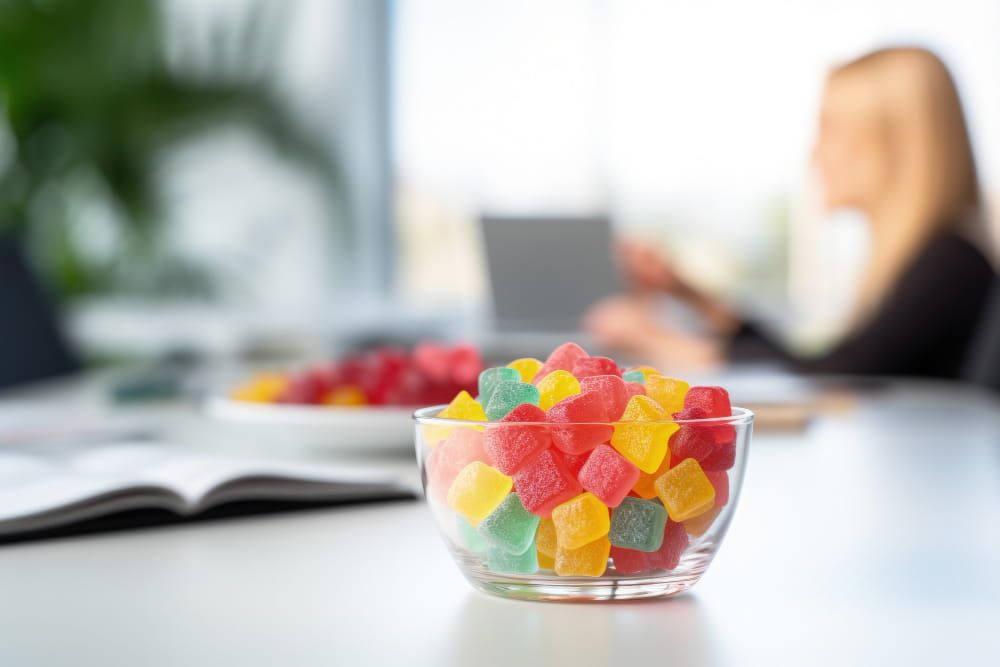
CBD gummies are chewable candies infused with cannabidiol, an extract from the cannabis plant that doesn't produce a high. They work by delivering CBD through your digestive system rather than under your tongue or through your lungs, which changes how fast they act, how long they last, and how much of the dose your body actually absorbs.
They have become the most approachable way into CBD for a simple reason: no dropper, no measuring, no earthy taste. But that convenience comes with some trade-offs in absorption that most product pages don't explain.
Here's how gummies differ from other CBD formats, what actually happens after you swallow one, and what's worth checking before you buy in Thailand.
How do CBD gummies differ from other CBD forms?
CBD gummies differ from oils, capsules, and topicals mainly in how the CBD enters your body, not in what the CBD itself does. Same compound, four different delivery routes, four different experiences.
Why do gummies take longer to work than oil?
Because they have to pass through your entire digestive system before any CBD reaches your bloodstream. Oil held under the tongue absorbs partly through the mucous membrane, skipping straight to circulation. A gummy has to be chewed, swallowed, broken down in the stomach, and processed by the liver first – which is slower by design, not by flaw.
Why do people still choose gummies over oil?
Three reasons show up consistently: no measuring, no taste, and a longer, steadier effect once it kicks in. A dropper bottle asks you to count drops and tolerate an earthy oil. A gummy is pre-dosed and tastes like a sweet. For someone new to CBD, that's often the difference between actually using the product and letting the bottle sit in a drawer.
Takeaway: Gummies trade a faster onset for convenience and a longer-lasting effect. Neither format is objectively better – the right one depends on whether you want speed or ease of use.
Understanding CBD absorption through edibles
CBD absorption through edibles is genuinely inefficient – most of what you swallow never reaches your bloodstream at all. This isn't a marketing gap; it's basic pharmacology, and it's worth understanding before you judge whether a gummy "worked."
Why does so little CBD actually reach your bloodstream?
CBD is fat-soluble and poorly absorbed by the gut on its own. What does get absorbed then passes through the liver before reaching general circulation – a process called first-pass metabolism. A pharmacokinetics review in Cannabis and Cannabinoid Research puts oral CBD bioavailability at roughly 9–13%, and a more recent 2025 crossover study cites figures as low as 6% under fasting conditions, noting that 70–75% of an orally consumed dose is metabolised by the liver before it ever reaches systemic circulation.
Put plainly: if a gummy contains 25 mg of CBD, the amount that ends up doing anything in your body could be closer to 2–3 mg, not 25.
Does that mean gummies are a worse product?
Not quite – it means the milligram number on the label isn't the whole story for any oral CBD format, including capsules and softgels. Sublingual oil isn't immune either; even absorbed under the tongue, some of the dose gets swallowed and follows the same digestive path. The honest comparison isn't "gummies are inefficient, oil isn't" – it's that all oral and sublingual routes lose a meaningful share of CBD to the same process, just to different degrees.
Does eating a gummy with food change anything?
Yes, and this is one of the few absorption facts worth actually acting on. Research consistently shows that taking CBD alongside a fatty meal improves absorption, because CBD is fat-soluble and needs lipids to help it cross into the bloodstream. A gummy eaten on an empty stomach after your morning coffee will likely perform differently than the same gummy eaten after lunch.
How long do the effects actually last?
Longer than oil, which is the trade-off for the slower onset. Because edibles are absorbed gradually as they move through digestion, effects tend to build slowly and last several hours rather than peaking and fading quickly. HappyLyfe's product data for gummies estimates 4–8 hours per dose, which lines up with what the slower, digestive absorption route would predict.
Takeaway: Only a fraction of the CBD in a gummy reaches your bloodstream, and that's true of every oral CBD format, not a gummy-specific flaw. Eating one with a meal that has some fat in it is the one adjustment backed by real research.
Key factors when exploring CBD gummies in Thailand
Three things matter more than flavour or brand name when you're choosing CBD gummies in Thailand: legality, what's actually on the label, and where the gummies came from.
Are CBD gummies legal in Thailand?
Yes, with conditions. CBD extracts containing no more than 0.2% THC, made from cannabis grown in Thailand under a Thai FDA licence, can be sold and bought without a prescription. Two things narrow that. Cannabis flower itself became prescription-only under the Ministry of Public Health's June 2025 Notification on Controlled Herbs, and a further Ministerial Regulation in April 2026 tightened flower licensing – though consumer CBD products like gummies weren't influenced by either change.
The part that catches people out: importing CBD gummies into Thailand is not legal, however the product is labelled or marketed online. A gummy made overseas and shipped to a Bangkok address isn't operating within Thai law, regardless of what the seller's website claims.
What should the label actually tell you?
Three things, and if a product is missing any of them, that's a reason to look elsewhere rather than assume the best:
● Milligrams per gummy. 125 mg on a jar of 10 gummies should also translate to 12.5 mg per piece.
● Full spectrum, broad spectrum, or isolate. Full spectrum keeps trace THC within the legal 0.2% limit; broad spectrum and isolate remove it entirely – worth knowing if you want to avoid THC altogether.
● A Thai FDA registration or equivalent licensing reference. This is what separates a legally sold product from one operating in a grey area.
Why does dosing matter more with gummies than with oil?
Because you can't easily split a gummy the way you can adjust drops from a dropper. If you're new to CBD, that pre-measured convenience becomes a limitation – you're locked into whatever milligram amount the manufacturer chose. Cutting a gummy in half is the practical workaround, and it's a reasonable one for a first try.
Start at the low end regardless of format. A single 10–15 mg gummy is a sensible first dose; give it a few days before deciding whether to go higher, since the slow, building onset of an edible means judging effects too quickly is a common way to conclude a product "doesn't work" before it's had a fair test.
How does HappyLyfe verify CBD gummy brands?
Every CBD product listed on HappyLyfe is checked against our six sensitivities – Organic, Cruelty-free, Free-range, Artisanal, Fair-trade, and Recycled – before it goes live. For gummies specifically, that means confirming the milligram claim on the label is backed by evidence, that the product is made from Thai-grown material under proper licensing, and that the THC figure is documented rather than just asserted on the packaging.
It's the part of buying an edible that's genuinely hard to check from a supermarket shelf – you can read a label, but you can't verify a manufacturer's testing process on your own.
Takeaway: Confirm the milligrams per piece, the spectrum type, and the licensing before you buy. In a category where labels can be vague by design, that check is the difference between a legitimate product and a guess.
Where can you buy CBD gummies in Thailand?
You can buy CBD gummies in Thailand through HappyLyfe's edibles range, which stocks clearly labelled, Thai-made CBD gummies from producers we've checked against our six sensitivities.
A few worth knowing by what they're formulated for:
● Diip Sleep, Morning, and Immunity Gummies (290฿ each, 125 mg) – three purpose-built options from a brand that grows its own hemp on a farm in Khao Yai, with each formula matched to a different part of the day.
● SEYA Full Spectrum Sleep Gummies (199฿ for 5 pieces, 349฿ for 10) – a smaller pack size if you want to test the format before committing to a full jar.
● Nativ Reishi Mushroom, CBD, L-Theanine, GABA & Tart Cherry Gummies (290฿) – a blended formula for anyone who wants CBD alongside other calming compounds rather than CBD alone.
Takeaway: Buy from a source that names its manufacturer and states milligrams per piece. HappyLyfe's edibles range does both, and every listing has been checked against our six sensitivities first.
Frequently asked questions
What are CBD gummies?
CBD gummies are chewable candies infused with cannabidiol, a non-intoxicating compound extracted from the cannabis plant. Unlike THC, CBD doesn't produce a high. They work the same way as any other CBD product – interacting with your body's endocannabinoid system – but delivered as an edible rather than an oil or capsule.
How long does it take for CBD gummies to work?
Typically 30 minutes to 2 hours, slower than sublingual oil because the gummy has to be digested before CBD reaches your bloodstream. Taking one with a meal that contains some fat can improve absorption. Effects then tend to last longer than oil, often several hours.
Are CBD gummies legal in Thailand?
Yes, if they contain no more than 0.2% THC and are made in Thailand from licensed, Thai-grown material. Importing CBD gummies into Thailand is not legal, regardless of how a foreign seller markets the product online.
Do CBD gummies get you high?
No. Legal CBD gummies in Thailand cap THC at 0.2%, far below the threshold that produces intoxicating effects. If you want to remove any THC entirely, choose a broad spectrum or isolate product rather than full spectrum.
How many CBD gummies should I take?
Start with a low dose – around 10–15 mg – and wait a few days before increasing. Because edibles absorb slowly, judging the effect after a single gummy often leads people to increase the dose before the first one has had a fair chance to work.
Where can I buy CBD gummies in Thailand?
HappyLyfe stocks Thai-made CBD gummies at happylyfe.in.th/cbd/edibles, including Diip's Sleep, Morning, and Immunity formulas and SEYA's Full Spectrum Sleep Gummies. Every brand is checked against our six sensitivities, and each listing states milligrams per piece.
The bottom line on CBD gummies
CBD gummies are an edible way to take cannabidiol, offering convenience and a longer-lasting effect in exchange for a slower onset and lower bioavailability than sublingual oil.
● Gummies, oil, capsules, and topicals deliver the same compound through different routes – the format changes speed and duration, not what CBD does.
● Only a fraction of the CBD in any oral product reaches your bloodstream; that's true of gummies, capsules, and swallowed oil alike.
● Eating a gummy with some dietary fat is the one absorption tip with real evidence behind it.
● In Thailand, legal means Thai-made, under 0.2% THC, and properly licensed – imports aren't legal regardless of labelling.
● Start with a low dose and give it days, not minutes, to judge whether it's working.
If you're ready to try one, browse HappyLyfe's CBD edibles range – every gummy listed is Thai-made, checked against our six sensitivities, and labelled with milligrams per piece so you're never guessing at the dose.